


When to Start Potty Training: A Pediatrician's Guide to Readiness Signs


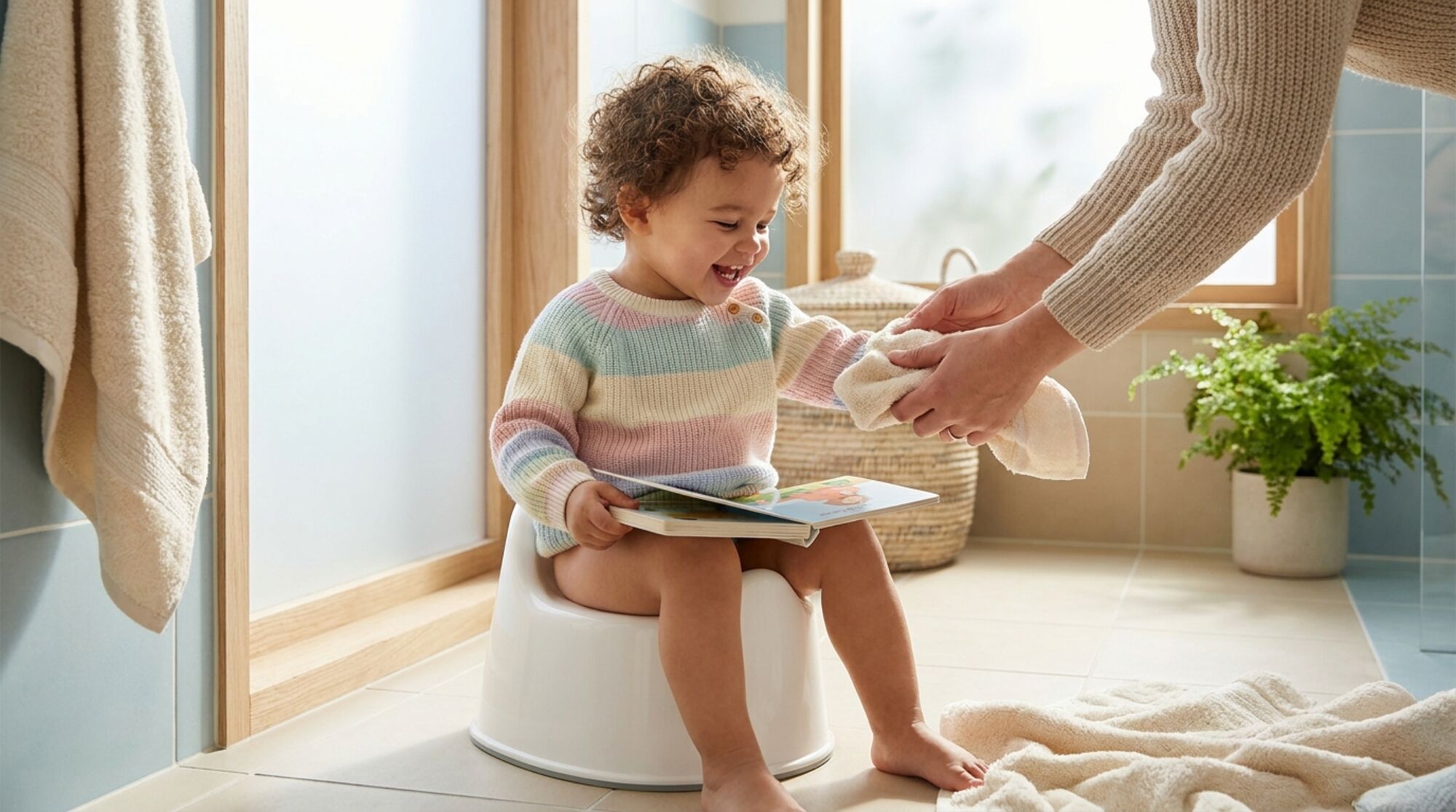
Most children are ready to start potty training between 18 and 36 months. The right time depends on your child's signs, not their birthday. The American Academy of Pediatrics (AAP) tells parents to watch for physical, behavioral, and cognitive readiness cues, and to wait until those cues show up. Readiness matters more than age.
"Most parents come in worried they are starting too late. In our experience, the family that waits for true readiness almost always has an easier time than the family that pushes by the calendar."
Blueberry Pediatrics Care Team
Key Takeaways
- Readiness comes before age. The AAP says children should not be pushed to start until they are physically, behaviorally, and developmentally ready.
- Most kids start between 18 and 36 months. The U.S. average is between 2 and 3 years old.
- About 6 in 10 children are trained by age 3, and nearly all are trained by age 4.
- Intensive training before 27 months does not get most kids trained any faster.
- Call your pediatrician for painful constipation, stool withholding, no progress by age 4, or regression with pain, fever, or unusual thirst.
Not sure if your child is ready, or worried about a recent setback?
Talk to a Blueberry pediatricianWhat Age Should You Start Potty Training?
Most parents start between 18 and 36 months. The U.S. average start is between ages 2 and 3, according to HealthyChildren.org, the parent-facing site of the American Academy of Pediatrics. The right age depends much more on your child's readiness than on a calendar number.
The Typical Age Range (18 to 36 Months)
A few primary-source numbers help set realistic expectations:
- The average age of first toilet-training success is about 27.7 months, and steady daytime success comes around 28.5 months.
- About 6 in 10 children are trained by age 3, and nearly all by age 4.
These are averages. The normal range is wide. If your 2-year-old is not interested yet, or your 3-year-old is still working on it, you are well inside normal.
Why Readiness Matters More Than Age
The body and the brain need to be ready before potty training can stick:
- Sphincter control (the muscle control needed to hold pee and poop) usually is not in place before 18 months.
- Cognitive readiness, the ability to connect the inner "I need to go" feeling with using the potty, usually shows up after the second birthday.
- Intensive training before 27 months does not lead to faster completion.
If your child shows several readiness signs, you can start. If not, wait a few weeks and try again. Pushing a child who is not ready usually leads to power struggles, accidents, and constipation, not faster training.
Signs Your Child Is Ready to Potty Train
Readiness shows up in three areas: physical, behavioral, and cognitive. No child needs every sign. Look for a cluster of cues across all three areas. The AAP emphasizes that readiness can spread out and rarely arrives all at once.
Physical Readiness Signs
- Stays dry for at least 2 hours at a stretch, or wakes up dry from naps. This is a sign the bladder is maturing.
- Walks easily to the potty and sits down steadily.
- Can pull pants and underwear up and down.
- Shows the "about to go" tells: grunting, squatting, freezing, a red face, or tugging at the diaper.
- Has regular, soft, formed bowel movements on a roughly predictable schedule.
Behavioral Readiness Signs
- Does not like the feeling of a wet or dirty diaper, and may ask to be changed.
- Shows interest in the toilet, in siblings or parents using it, or in "big kid" skills.
- Wants to do things "myself" and takes pride in small accomplishments.
- Can follow simple instructions and cooperate with a short routine.
Cognitive and Language Readiness Signs
- Connects the inner feeling of a full bladder or rectum with the act of going.
- Has words or signs for pee, poop, and the potty, and can tell you before or during going.
- Can remember where they are headed and ignore distractions on the way.
- Follows the steps of a short sequence: pants down, sit, wipe, flush, hands.
If most of these are in place, your child is probably ready. If only one or two are showing up, it is okay to wait. The AAP frames the whole process as child-led, not parent-led.
How to Start Potty Training: Step-by-Step
Here is a simple plan, based on HealthyChildren.org. You do not need fancy gear or a chart full of stickers. You need a routine, neutral words, and patience.
- Pick your words. Choose simple, family-friendly words for body parts, pee, and poop. Avoid words like "dirty" or "stinky." Neutral words keep shame out of the routine.
- Get a potty chair. A small, child-sized seat with a removable container works well. Your child's feet should reach the floor. Stable footing helps with control.
- Build a routine. Have your child sit on the potty at predictable times: first thing in the morning, after meals, and before bath. A short book can make potty time feel calm and positive.
- Teach the cues. Name the cues out loud the moment you see them. "Looks like you are doing the potty dance. Let's try the potty." This helps your child link the body feeling to the action.
- Praise effort, not just success. Steady, low-key praise works better than big rewards.
- Model it. Let your child watch a parent or older sibling use the toilet and wash hands. Toddlers learn by copying.
- Hand over control. Talk about pee and poop as your child's job, not yours. The AAP calls this "toilet mastery." Kids who feel in charge stay more motivated.
Never punish accidents. The AAP is clear: pushing, shaming, or punishing for accidents backfires. Take a break of a few weeks if the process feels stuck.
Common Potty Training Methods
You will hear about a lot of methods. Most fall into two camps: a fast, intensive approach, or a slow, child-led approach. Only the gradual approach has outcome data from peer-reviewed studies.
The 3-Day Method
The 3-day method is an intensive, parent-led approach. You clear your calendar, put your child in underwear, and stay home for a few days of focused practice, hourly potty visits, and lots of fluids.
It can work for a child who is already showing clear readiness signs and who is comfortable with the parent's full attention for several days. No primary source supports a fixed 3-day timeline, and intensive training before 27 months does not give children a head start.
If you try this approach, do not start before your child shows steady readiness, and be ready to pause if your child becomes upset or starts withholding.
The Child-Led (Gradual) Method
The child-led method is the AAP-aligned default, and it has the strongest track record in pediatric research. Parents follow the child's readiness for each step instead of pushing a timeline:
- Introduce the potty chair when your child is around 18 to 24 months and curious.
- Move on to sitting in clothes, then with the diaper off, only when your child is comfortable.
- Try regular pants once your child uses the potty reliably for several days.
- Take a break if your child resists, then try again in a few weeks.
This route is slower at the start, but outcomes are strong, and power struggles and constipation are less common.
Potty Training Boys vs. Girls: What's Different?
On average, boys finish potty training about 6 months later than girls (HealthyChildren.org). The AAP is careful with this number. "Gender itself has little to do with how early or late a child becomes fully toilet-trained," the AAP writes. Differences in activity level and overall readiness timing matter more than sex.
A few practical tips:
- Many boys find it easier to sit for both pee and poop first, then switch to standing for pee once the basics are solid.
- A foot-supported potty chair helps with both.
- Keep individual readiness as your main signal. A ready boy will train faster than a not-ready girl.
Do not start earlier for a girl or wait longer for a boy just because of sex. Watch your individual child.
Troubleshooting Common Potty Training Problems
Even with a smooth start, almost every family hits a few bumps. Most are normal and pass on their own. A few need a quick check-in with your pediatrician.
Accidents and Regression
Accidents are normal during and after potty training. HealthyChildren.org notes that accidents "sometimes continue for months after the toilet training process appears complete, even when a child is three or four years old." This is part of the process, not failure.
Regression, where a previously trained child starts having accidents again or asks for diapers back, often follows a change at home: a new baby, a move, a new caregiver or preschool, illness, or family stress. It can also signal a medical cause, especially a urinary tract infection (UTI) or constipation.
Rule out a medical cause first
When a previously trained child regresses, have the pediatrician check for a physical cause before changing your routine. Regression can signal an infection or another condition that needs treatment.
Once a medical cause is ruled out, react calmly. Walk back to the basics: regular potty sits, praise for effort, no punishment, and a steady routine for a few weeks.
Refusal and Power Struggles
Many toddlers go through a stage of refusing the potty. They are testing control, not failing. If you push, you can turn refusal into constipation.
"Holding back stools because of power struggles is the most common cause of recurrent constipation in children, most often occurring during toilet training," HealthyChildren.org reports. Up to 1 in 5 children show stool toileting refusal at some point. For most, it passes; for about one in four of those, a pediatrician's help is useful.
Two terms to know:
- Stool withholding is when a child holds in poop on purpose, often to avoid a painful poop or to keep control.
- Constipation means hard, dry, or painful poops (the hardness matters more than how often).
If refusal is steady, the simplest plan is to step back. Put your child back in diapers or pull-ups for a few weeks, drop the potty conversation, and try again later. A break is not a defeat. It is good pediatric practice. (Learn more in our guide to toddler constipation and what green poop means.)
Nighttime Training and Bedwetting
Nighttime dryness comes later than daytime dryness, and on its own timeline. Many kids are dry during the day for months, or even a year, before they are reliably dry at night.
About 1 in 5 children still wet the bed at age 5 (HealthyChildren.org). That is usually normal, and the AAP notes that "bedwetting almost always goes away on its own." Doctors only call it "nocturnal enuresis" (the medical word for bedwetting) when it continues beyond age 5.
For most kids, nighttime training is about waiting, not training. Use a waterproof mattress cover, keep nighttime calm and matter-of-fact, and skip the punishment. Call your pediatrician if bedwetting is new after 6 months of dry nights, painful, or paired with increased thirst, increased urination, or burning.
When to Talk to Your Pediatrician
Most potty training questions ("Is this normal?" or "Why is my child suddenly having accidents?") are great for a quick telehealth visit. A few situations need an in-person check.
Call your pediatrician if:
- Your child has painful constipation or is holding in poop. An in-person exam may be needed to check for a stool impaction.
- Your child has shown no potty training progress by age 4, or shows no readiness signs well past age 3.
- A previously trained child suddenly starts having accidents, especially with pain, fever, blood in the urine, or unusual thirst or urination. These can point to a UTI or another condition that needs care.
- Bedwetting starts up again after 6 or more months of dry nights, or comes with daytime symptoms.
In our telehealth visits, the most common parent questions are how to tell if a child is really ready, and what to do when a child who was doing well suddenly starts having accidents. Both are well suited to a quick virtual visit. Suspected constipation causing pain, or a possible UTI, needs an in-person exam.
Worried about constipation, regression, or a refusal that is lasting weeks?
Message a Blueberry pediatrician nowFrequently Asked Questions
Does the 3-day method really work? It can work for a child who already shows clear readiness signs, but there is no fixed timeline. Intensive training before 27 months does not lead to faster completion than the gradual approach.
How is potty training boys different from girls? Boys average about 6 months later than girls, but the AAP says individual readiness matters far more than sex. Many boys do well sitting for both pee and poop first, then switching to standing later. See our pediatrician's guide to potty training boys for step-by-step tips.
What do I do about accidents and regression? Accidents are normal for months after "finished" training. If a previously trained child starts having accidents again, have your pediatrician rule out a UTI or constipation first, then walk back to a calm, basic routine. A sudden behavior shift can also overlap with common toddler sleep regressions.
What if my child refuses to use the potty? Refusal is common. Do not push or punish, which can turn into stool withholding and constipation. Take a break of a few weeks and try again.
When should my child be night-trained, and what about bedwetting? Nighttime dryness comes later than daytime, on its own clock. About 1 in 5 children still wet the bed at age 5, which is usually normal. It almost always resolves on its own.
Can you start potty training too early? Before about 18 months, the body usually cannot control elimination yet. Intensive training before 27 months gives no proven head start.
Is it normal for my child not to be potty trained by age 3? Yes. About 4 in 10 children are still potty training at age 3. Nearly all are trained by age 4.
Have a potty training question that does not fit any of these?
Start a Blueberry visitThis article is for general education and is not a substitute for your pediatrician's advice. If you have concerns about your child's development or health, please reach out to your pediatrician.
References
- American Academy of Pediatrics, HealthyChildren.org. "The Right Age to Potty Train." https://www.healthychildren.org/English/ages-stages/toddler/toilet-training/Pages/the-right-age-to-toilet-train.aspx
- American Academy of Pediatrics, HealthyChildren.org. "How to Tell When Your Child Is Ready." https://www.healthychildren.org/English/ages-stages/toddler/toilet-training/Pages/How-to-Tell-When-Your-Child-is-Ready.aspx
- American Academy of Pediatrics, HealthyChildren.org. "Psychological Readiness and Motor Skills Needed for Toilet Training." https://www.healthychildren.org/English/ages-stages/toddler/toilet-training/Pages/Psychological-Readiness-and-Motor-Skills-Needed-for-Toilet-Training.aspx
- American Academy of Pediatrics, HealthyChildren.org. "Cognitive and Verbal Skills Needed for Toilet Training." https://www.healthychildren.org/English/ages-stages/toddler/toilet-training/Pages/Cognitive-and-Verbal-Skills-Needed-for-Toilet-Training.aspx
- American Academy of Pediatrics, HealthyChildren.org. "Is It True That Boys Are Usually Toilet-Trained Later Than Girls?" https://www.healthychildren.org/English/tips-tools/ask-the-pediatrician/Pages/is-it-true-boys-usually-toilet-trained-later-than-girls.aspx
- American Academy of Pediatrics, HealthyChildren.org. "Create a Potty Training Plan for Your Child." https://www.healthychildren.org/English/ages-stages/toddler/toilet-training/Pages/creating-a-toilet-training-plan.aspx
- American Academy of Pediatrics, HealthyChildren.org. "Potty Training Regression." https://www.healthychildren.org/English/ages-stages/toddler/toilet-training/Pages/Regression.aspx
- American Academy of Pediatrics, HealthyChildren.org. "Constipation in Children." https://www.healthychildren.org/English/health-issues/conditions/abdominal/Pages/constipation.aspx
- American Academy of Pediatrics, HealthyChildren.org. "Bedwetting in Children and Teens: Nocturnal Enuresis." https://www.healthychildren.org/English/health-issues/conditions/genitourinary-tract/Pages/Nocturnal-Enuresis-in-Teens.aspx
- American Academy of Family Physicians. "Toilet Training: Common Questions and Answers." American Family Physician 2019;100(8):468-474. https://www.aafp.org/afp/2019/1015/p468
- Brazelton TB. "A Child-Oriented Approach to Toilet Training." Pediatrics. 1962;29(1):121-128. https://publications.aap.org/pediatrics/article/29/1/121/77640


.svg)





.svg)
.svg)

