


Normal Temperature for a Baby (and When It's a Fever)


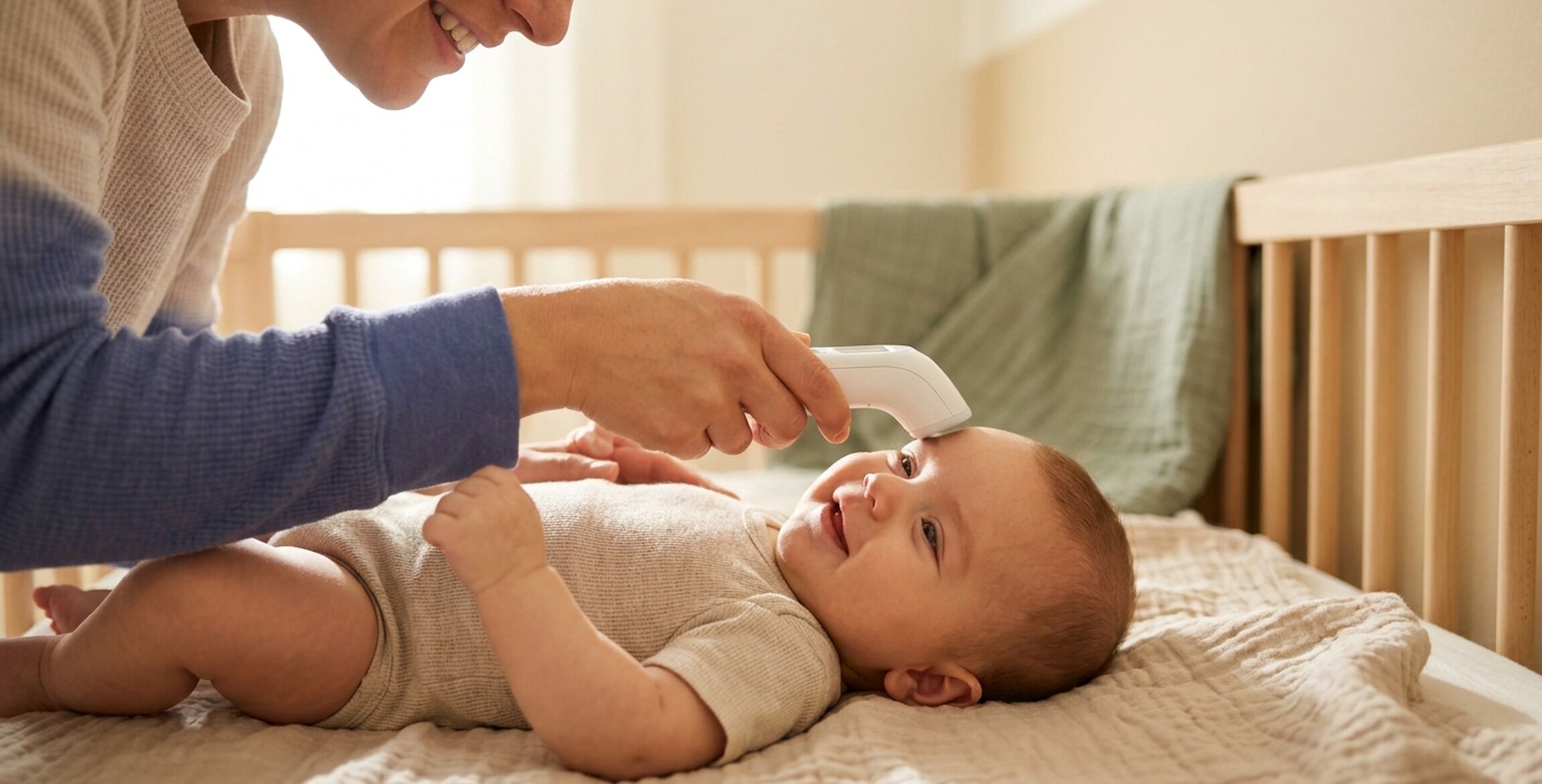
A normal infant temperature is roughly 97.5 to 99.5 degrees Fahrenheit (36.4 to 37.5 degrees Celsius). A fever is a rectal reading of 100.4 degrees Fahrenheit (38 degrees Celsius) or higher. The exact number depends on how you take the reading and how old your baby is.
In Blueberry telehealth visits, the most common question we hear about infant temperature is “is this normal?” The honest answer depends on two things. The first is how you measured the temperature. The second is your baby's age. This guide covers both.
Key Takeaways
- A normal baby temperature runs roughly 97.5 to 99.5 degrees Fahrenheit (36.4 to 37.5 degrees Celsius), with about 98.6 degrees Fahrenheit (37 degrees Celsius) as the average.
- The exact “normal” number depends on how you take the temperature. Rectal readings run highest and are the most accurate. Armpit readings run lower and are a screening method only.
- A baby has a fever when the rectal temperature is 100.4 degrees Fahrenheit (38 degrees Celsius) or higher.
- Is your baby younger than 3 months old, with a rectal temperature of 100.4 degrees Fahrenheit (38 degrees Celsius) or higher? Call your pediatrician right away, or go to the emergency department. This is true even if your baby otherwise looks fine.
What Is a Normal Temperature for a Baby?
A normal infant temperature falls in the range of about 97.5 to 99.5 degrees Fahrenheit (36.4 to 37.5 degrees Celsius). The often-quoted figure of 98.6 degrees Fahrenheit (37 degrees Celsius) is an average, not a fixed number every baby must hit.
The American Academy of Pediatrics (AAP) puts it this way:
“Normal body temperature varies with age, general health, activity level and time of day.”
American Academy of Pediatrics
Infants tend to run a little warmer than older children. A baby who has been crying, bundled in blankets, or playing in a warm room may read a few tenths higher. That is still normal.
What matters most is not the single number on the thermometer. It is the method you used and the age of your baby. A reading of 99.0 degrees Fahrenheit (37.2 degrees Celsius) under the armpit means something very different from the same reading taken rectally.
Why Does My Baby's Temperature Change Through the Day?
Body temperature is not a flat line. It rises and falls on a daily rhythm. The AAP notes that temperature is “highest between late afternoon and early evening, and lowest between midnight and early morning.”
A baby's temperature can also shift with:
- Activity (crying, feeding, or moving)
- Clothing or bundling
- Room temperature
- Time of day
- Recent vaccines
None of these mean your baby is sick. They are normal physiology.
A practical takeaway: a borderline-warm number after a crying spell or a warm car-seat nap is not a rising fever. Unbundle your baby. Wait 15 to 20 minutes in a normal-temperature room. Check again.
Babies under 3 months
Daily variation never softens the under-3-months rule. Is your baby under 3 months old, with a rectal reading of 100.4 degrees Fahrenheit (38 degrees Celsius) or higher? Call your pediatrician or go to the emergency department. Full stop.
How Do I Take My Baby's Temperature?
The right method depends on your baby's age. Here is how each option compares.
Rectal Temperature (Most Accurate for Babies Under 3 Months)
For babies under 3 months old, an infant rectal temperature is the gold standard. The AAP states: “Taking a rectal temperature gives the best reading, especially for infants under 3 months of age.”
To take a rectal temperature safely:
- Use a digital thermometer made for rectal use.
- Lubricate the tip with a small amount of petroleum jelly.
- Lay your baby on the back or belly with the diaper off.
- Gently insert the tip about 1/2 inch for babies under 6 months, or up to 1 inch for older babies. Stop if you feel any resistance.
- Hold the thermometer steady until it beeps.
- Wipe the thermometer with alcohol after each use, and label it so it stays the “rectal” thermometer only.
A rectal reading of 100.4 degrees Fahrenheit (38 degrees Celsius) or higher is the AAP-defined fever threshold at any age. It is the only threshold you should use to decide whether a baby under 3 months needs urgent care.
Armpit (Axillary) Temperature
An axillary temperature for an infant, also called an armpit reading, is a screening method. The AAP describes the armpit as the “least accurate, but you can use this method to screen.” It runs about 1 degree Fahrenheit lower than rectal.
To take an armpit temperature:
- Use a digital thermometer.
- Place the tip in the center of the bare armpit, not over clothing.
- Hold your baby's arm snugly against the body so the tip stays covered.
- Wait for the beep.
A screening cutoff of about 99 degrees Fahrenheit (37.2 degrees Celsius) on the armpit is commonly taught as the point to confirm rectally. If your baby is under 3 months old and the armpit reading is at or above this number, take a rectal temperature first. Confirm before deciding what to do next.
Forehead (Temporal Artery) Temperature
Temporal artery, or forehead, thermometers scan the artery just above the eyebrow. The AAP rates this as the “next most accurate” method after rectal.
To use one:
- Hold the scanner flush against the center of the forehead.
- Slide it across to the hairline at the temple, following the device's instructions.
- Keep the area dry. Sweat can throw the reading off.
A forehead reading of 100.4 degrees Fahrenheit (38 degrees Celsius) or higher counts as a fever. For a baby under 3 months, confirm any positive forehead reading with a rectal temperature before deciding on next steps.
Why not oral or ear thermometers for young babies? Oral thermometers are not recommended until age 4 or older. Tympanic (ear) thermometers can be used starting at 6 months but are not reliable for younger babies, whose ear canals are too narrow.
Temperature by Measurement Method and Age (Comparison Table)
Use this table as a quick reference. The fever threshold across every method is the same number. The “normal” range and best-use age vary.
| Method | Best age range | Accuracy | Approximate normal range | Fever threshold |
|---|---|---|---|---|
| Rectal | All ages; preferred under 3 months | Most accurate (AAP-preferred) | 97.9 to 100.3 °F (36.6 to 37.9 °C) | 100.4 °F (38 °C); AAP definition |
| Temporal artery (forehead) | All ages | Second-most accurate; technique sensitive | About 97.0 to 100.0 °F (36.1 to 37.8 °C) | 100.4 °F (38 °C); confirm rectally under 3 months |
| Tympanic (ear) | 6 months and older | Accurate when done correctly; not reliable under 6 months | About 96.4 to 100.4 °F (35.8 to 38 °C) | 100.4 °F (38 °C) at the ear; rectal is definitive |
| Axillary (armpit) | Screening only | Least accurate; runs lower than rectal | About 97.5 to 99.3 °F (36.4 to 37.4 °C) | Screening cutoff about 99 °F (37.2 °C); confirm rectally |
A note on the numbers: the rectal fever threshold of 100.4 degrees Fahrenheit (38 degrees Celsius) is AAP-defined. The other method-specific normal ranges are commonly taught pediatric approximations, not AAP-published cutoffs.
What Temperature Counts as a Fever in a Baby?
A baby has a fever when the rectal temperature is 100.4 degrees Fahrenheit (38 degrees Celsius) or higher. This is the AAP definition and applies at every age. The CDC uses the same threshold, calling fever “a measured temperature of 100.4 degrees Fahrenheit (38 degrees Celsius) or greater.”
Forehead, ear, and armpit readings at or above this number should be confirmed with a rectal reading. This is especially important for a baby under 3 months old.
A fever is not, by itself, an illness. It is a sign that the body is doing something, most often fighting off a virus. What the fever means depends on your baby's age, behavior, and other symptoms. If your baby does have a fever, here is what to do next. See our guides on baby fever and newborn fever. Also see how to dress your baby with a fever at night and how to tell if your newborn is too hot.
When to Call Your Doctor or Go to the ER
Call right away if your baby is under 3 months old with a rectal reading of 100.4 degrees Fahrenheit (38 degrees Celsius) or higher. Other readings can also prompt an immediate call to your pediatrician or a trip to the emergency department.
Is your baby younger than 3 months old, with a rectal temperature of 100.4 degrees Fahrenheit (38 degrees Celsius) or higher? Call your pediatrician right away, or go to the emergency department. This is true even if your baby otherwise seems fine. A telehealth visit is not enough at this age. Your baby needs to be seen in person.
Other times to call your doctor:
- The temperature climbs above 104 degrees Fahrenheit (40 degrees Celsius) on more than one reading, at any age
- A fever lasts longer than 24 hours in a child under 2 years old
- A fever lasts longer than 3 days in a child 2 years or older
- Your baby is unusually sleepy, hard to wake, refusing fluids, breathing fast, or seems “not themselves”
Why so urgent for the youngest babies? In babies under 3 months, a fever can be the first sign of a serious bacterial infection that worsens quickly. The 2021 AAP clinical practice guideline covers well-appearing febrile infants 8 to 60 days old. It recommends in-person evaluation and lab testing. In the youngest age band, it recommends hospital admission for empiric IV antibiotics. This is not a wait-and-see age group.
How Blueberry Pediatrics Can Help
For older babies and “is this normal?” questions, Blueberry Pediatrics gives you a fast, in-home way to talk through a reading with a pediatrician. Our team can walk you through how to confirm a borderline number. We can help you decide whether it reflects bundling or a true fever. We can tell you what to watch for next.
Talk through a borderline reading with a pediatrician from your phone.
Start a visitOne exception, on purpose. For any baby under 3 months old, a rectal reading of 100.4 degrees Fahrenheit (38 degrees Celsius) or higher requires in-person evaluation. Telehealth is not a substitute. Call your pediatrician immediately or go to the emergency department.
Frequently Asked Questions
What is a normal temperature for a baby or newborn?
A normal infant temperature is roughly 97.5 to 99.5 degrees Fahrenheit (36.4 to 37.5 degrees Celsius). That range applies to newborns and older babies. The average is around 98.6 degrees Fahrenheit (37 degrees Celsius). The exact number depends on how you took the reading and your baby's age.
What temperature is too high for a baby?
A rectal temperature of 100.4 degrees Fahrenheit (38 degrees Celsius) or higher is a fever at any age. For a baby under 3 months, that reading is also the threshold for urgent in-person evaluation.
What is the most accurate way to take a baby's temperature?
Rectal. The AAP recommends rectal readings as the most accurate option, especially for infants under 3 months. Forehead (temporal artery) thermometers are the next most accurate.
How do I take a rectal temperature on a baby safely?
Use a digital thermometer made for rectal use. Lubricate the tip with a small amount of petroleum jelly. Gently insert about half an inch for babies under 6 months, or up to one inch for older babies, and hold steady until the beep. Stop if you feel resistance, and never force it.
Is an armpit (axillary) temperature accurate for a baby?
Armpit readings are a screening method only. They run about a degree Fahrenheit lower than rectal. If the armpit reading is at or above about 99 degrees Fahrenheit (37.2 degrees Celsius), confirm with a rectal reading. Decide next steps from that confirmed number.
Does a baby's normal temperature change during the day?
Yes. Body temperature is typically lowest in the early morning and highest in the late afternoon or early evening. Crying, feeding, bundling, and a warm room can also push the number up briefly without meaning your baby is sick.
At what temperature should I call the doctor for my baby?
Call right away if your baby is under 3 months old with a rectal reading of 100.4 degrees Fahrenheit (38 degrees Celsius) or higher. For older babies, call if the temperature goes above 104 degrees Fahrenheit (40 degrees Celsius). Call if a fever lasts more than 24 hours under age 2. Call if your baby seems unusually sleepy, hard to wake, or “not themselves.”
Why does my newborn feel warm but the thermometer reads normal?
Newborns can feel warm from bundling, a warm room, recent feeding, or being held against your skin. If you are unsure, unwrap your baby, wait 15 to 20 minutes in a normal-temperature room, and check the temperature again with a rectal thermometer.
Sources
- American Academy of Pediatrics. “Signs and Symptoms of Fever.” HealthyChildren.org.
- American Academy of Pediatrics. “How to Take a Child's Temperature.” HealthyChildren.org.
- American Academy of Pediatrics. “Fever and Your Baby.” HealthyChildren.org.
- Pantell RH, Roberts KB, Adams WG, et al. Evaluation and Management of Well-Appearing Febrile Infants 8 to 60 Days Old. Pediatrics. 2021;148(2):e2021052228.
- CDC Port Health. Definitions of Signs, Symptoms, and Conditions of Ill Travelers.

.svg)





.svg)
.svg)

