


Potty Training Tips: A Pediatrician's Guide for Parents


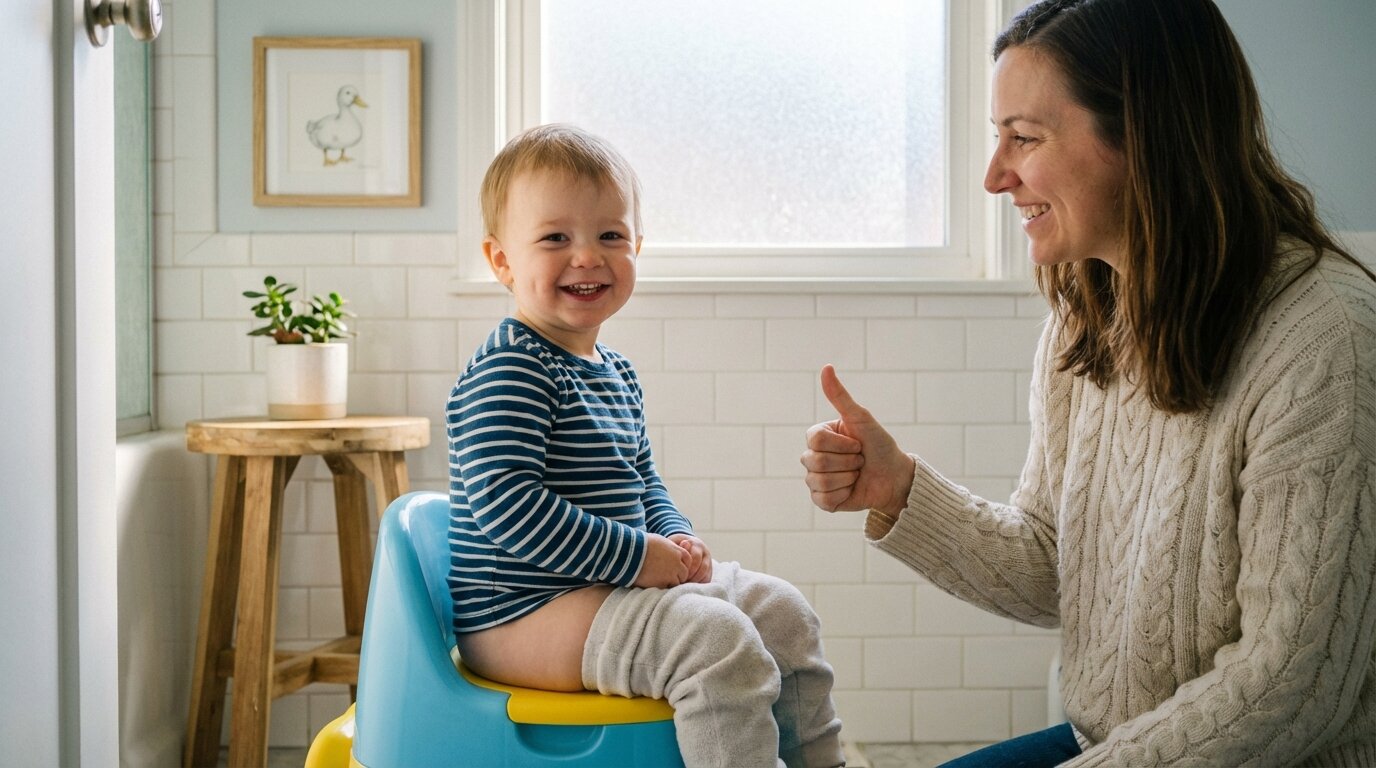
Most children are ready to start potty training between 18 and 30 months old, but every child develops at their own pace. The best potty training tips focus on watching for signs of readiness, staying patient, and using positive encouragement. According to the American Academy of Pediatrics (AAP), a child-led approach works best — meaning you follow your child's cues rather than picking an age and forcing it. With the right timing and a calm, supportive approach, most children master daytime potty training between ages 2 and 3.
Key Takeaways
- Watch for readiness signs — not a specific age — before starting potty training
- Use a child-sized potty chair on the floor so your child feels safe and stable
- Praise every success and stay calm about accidents — punishment backfires
- Expect the process to take weeks to months — rushing makes it take longer
- Daytime and nighttime dryness are different skills — nighttime training comes later and is not something you can rush
- Talk to your pediatrician if your child is over 3.5 and not making progress, or if a fully trained child suddenly starts having frequent accidents
Is Your Child Ready for Potty Training?
Starting before your child is truly ready is one of the most common potty training mistakes. Research shows that children who start training before 27 months often take longer to finish than those who start a bit later.
Your child may be ready if they show several of these signs:
Body Readiness
- Stays dry for at least 2 hours at a time or wakes up dry from naps
- Has regular, predictable bowel movements
- Can walk to the bathroom and sit on the potty without help
- Can pull pants up and down
Brain Readiness
- Follows simple instructions like "go get your shoes"
- Uses words for pee and poop (or shows you through gestures)
- Knows when they are going — they might pause, squat, or hide in a corner
Emotional Readiness
- Shows interest in the toilet or wants to watch family members use it
- Feels bothered by wet or dirty diapers and wants them changed
- Wants to do things "by myself" and feels proud of accomplishments
You do not need to wait for every single sign. But seeing several of them together means your child's body and brain are likely ready.
When to Start Potty Training
The AAP recommends introducing the idea of the potty around 18 months. At this age, you can start by:
- Letting your child watch you or older siblings use the bathroom
- Using simple words like "pee" and "poop" so they learn the vocabulary
- Showing them how you dump the contents of a dirty diaper into the toilet
Actual practice — sitting on the potty bare-bottomed — should wait until your child shows clear readiness signs. For most children, this happens between 21 and 30 months.
Important timing tip: Do not start potty training during a stressful time. A new baby, a move to a new house, starting daycare, or family changes can make training harder. Wait until things feel settled.
Step-by-Step Potty Training Tips
1. Get the Right Equipment
The AAP recommends starting with a small potty chair that sits on the floor — not a seat that goes on top of the adult toilet. A floor-level potty lets your child:
- Plant their feet firmly on the ground (this actually helps with pushing during bowel movements)
- Feel stable and secure, which reduces fear of falling
- Get on and off independently
2. Make It Routine
Set regular times to try the potty:
- After waking up in the morning or from a nap
- About 15 to 30 minutes after meals
- Before bath time
Keep each sitting short — about 3 to 5 minutes. If nothing happens, that is okay. Say something like "good try!" and move on.
3. Praise, Don't Punish
Positive encouragement is the foundation of successful potty training. When your child uses the potty:
- Give specific praise: "You went pee on the potty — great job!"
- Use small rewards like stickers or high-fives
- Let them feel proud of themselves
When accidents happen (and they will):
- Stay calm and neutral
- Say something simple like "oops, that's okay — we'll try the potty next time"
- Never scold, shame, or express frustration — this can lead to anxiety and stool withholding, which creates much bigger problems
4. Transition to Underwear Gradually
Keep using diapers or pull-ups until your child is having regular success on the potty. Switching to underwear too early can cause stress and more accidents. When your child is staying dry most of the day, try "big kid underwear" at home first, then expand to outings.
5. Be Patient With Bowel Training
Many children learn to pee on the potty before they are comfortable pooping on it. This is completely normal. About 1 in 5 children go through a phase called stool toileting refusal — they will pee in the potty but insist on a diaper to poop.
Do not force it. If your child asks for a diaper to poop, it is okay to give them one for now. Pressuring a child to poop on the potty can trigger stool withholding, which can lead to constipation, pain, and a cycle that is hard to break.
Potty Training Boys vs. Girls
Research shows that girls tend to complete potty training a few months earlier than boys on average. This is not about intelligence — there are several reasons for the difference:
- Language development: Girls often develop verbal skills slightly earlier, which helps with communicating bathroom needs
- Anatomy: Boys face a two-step learning curve — first sitting to pee, then later standing and aiming
- Activity level: Toddler boys sometimes find it harder to pause active play for a bathroom break
For boys: Start with sitting for both pee and poop. Standing to pee can come later once they have the basics down.
For girls: Always teach wiping from front to back to prevent urinary tract infections.
Both boys and girls benefit from the same core approach: watch for readiness, use positive reinforcement, and stay patient.
Common Potty Training Problems (and How to Handle Them)
Constipation and Stool Withholding
This is the number one medical cause of potty training problems. Here is what happens:
- Your child has one hard, painful poop
- They start holding in their poop to avoid the pain
- The held stool gets harder and larger, making the next poop even more painful
- The cycle continues and can become a serious problem
What to do:
- Make sure your child gets enough fiber (fruits, vegetables, whole grains)
- Keep them well hydrated with water throughout the day
- Talk to your pediatrician if your child goes more than 2 to 3 days without a bowel movement or has very hard stools
- Never force a child to sit on the potty when they are scared
Fear of the Toilet
Some children are genuinely frightened of the toilet — the loud flush, the splash of water, or the feeling that part of their body is disappearing down the drain. This is a real and common fear for toddlers.
What to do:
- Use a small potty chair instead of the big toilet
- Let your child flush after they walk away if the noise bothers them
- In public restrooms, cover automatic flush sensors with a sticky note to prevent surprise flushes
Potty Training Regression
It is completely normal for a child who was doing well to suddenly start having accidents again. Common triggers include:
- Life changes: A new sibling, a move, starting preschool, or a divorce
- Illness or constipation: Being sick can temporarily disrupt training progress
- Developmental leaps: When your child's brain is focused on learning a new big skill (like talking in sentences), other skills can temporarily slip
What to do:
- Stay calm — regression is temporary and does not mean training has failed
- Go back to basics: offer more frequent potty reminders and positive encouragement
- Avoid punishment or shaming, which will make regression worse
- If regression lasts more than a few weeks or is accompanied by pain, straining, or other symptoms, talk to your pediatrician
Nighttime Potty Training: A Different Timeline
Here is something many parents do not realize: daytime dryness and nighttime dryness are controlled by completely different body systems. Daytime potty training is a skill your child learns. Nighttime dryness depends on biological maturation — specifically, the brain producing enough of a hormone called vasopressin (antidiuretic hormone) to concentrate urine during sleep.
What is normal:
- A fully daytime-trained 3-year-old who still needs a pull-up at night is completely normal
- About 15 to 20 percent of 5-year-olds still wet the bed regularly
- The body resolves this on its own at a rate of about 15 percent per year after age 5
- Bedwetting runs in families — if one parent was a late bedwetter, their child is more likely to be one too
What to do:
- Use pull-ups or waterproof mattress covers without shame
- Limit fluids in the hour before bedtime
- Waking your child to use the bathroom at night may reduce wet nights in the short term, but it does not speed up the body's natural maturation process and is not necessary
- Talk to your pediatrician if your child is 5 or older and bedwetting is causing distress, or routinely by age 7 if it persists. Also consult your doctor if a child who was dry at night starts wetting again
Potty Training at Daycare: Keeping Things Consistent
If your child attends daycare or preschool, consistency between home and school is essential for success. Children can get confused when the rules and routines are different in different places.
Tips for coordination:
- Create a plan together: Talk with your child's teachers about your approach and agree on the same method
- Use the same words: Make sure everyone uses the same terms for bathroom activities
- Match the schedule: If daycare offers potty breaks after meals and snacks, try to do the same at home
- Dress for success: Send your child in clothes with elastic waistbands that they can pull down quickly — skip overalls, buttons, and belts
- Pack extra clothes: Send plenty of changes so accidents can be handled calmly and without stress
When to Talk to Your Pediatrician
Most potty training challenges resolve with time and patience. But you should talk to your child's doctor if you notice:
- No interest or progress by age 3.5 despite consistent, patient efforts
- Pain with urination or bowel movements — this could signal a urinary tract infection or constipation that needs treatment
- Constant dribbling of urine (not regular accidents, but a small continuous leak) — in girls, this can indicate a structural issue
- Sudden regression with other symptoms like leg weakness, changes in walking, or back pain — these are rare but can indicate a neurological issue
- Chronic constipation lasting more than 2 weeks or stool withholding that is not improving
- Your child was fully trained but starts having daily accidents — especially if paired with increased thirst or weight loss, which could signal diabetes
Remember: there is a wide range of normal when it comes to potty training. Most healthy children are fully day-trained between ages 2 and 4. If your child is taking longer, it does not mean anything is wrong — but your pediatrician can help rule out any medical issues and offer personalized guidance.
Popular Potty Training Methods
There are three main approaches to potty training. Each has its strengths, and many families end up using a combination.
Child-Led Approach (Brazelton Method)
This is the approach recommended by the AAP. You watch for your child's readiness signs and let them set the pace. Training typically takes 3 to 6 months but tends to be lower-stress for both parent and child. It is the most widely recommended approach by pediatricians. Best for: Families who can be patient and flexible with timing.
Intensive Training (Azrin and Foxx / 3-Day Method)
Based on the original Azrin and Foxx (1974) research, this approach involves a concentrated training period — usually a long weekend — with frequent practice, lots of fluids, and immediate positive reinforcement. It can produce faster initial results, but some children show more resistance with this method compared to a child-led approach. Best for: Older toddlers (2.5 to 3+) who show strong readiness signs and families who can dedicate several uninterrupted days.
Elimination Communication (EC)
This approach starts in infancy, often before 6 months, and involves learning to read your baby's signals for when they need to go. Parents hold the baby over a potty or toilet at those times. It requires significant time and attention and is more common in some cultures than others. Most families who practice EC still use diapers as backup. Best for: Families with a stay-at-home caregiver who can closely observe the baby throughout the day.
Which Method Should You Choose?
The AAP recommends the child-led approach for most families. Whatever method you choose, the most important factors are your child's readiness, your family's schedule, and a positive attitude throughout the process. If one approach is not working, it is perfectly fine to switch or combine methods.
Related: Toddler Sleep Routines | Toddler Sleep Regression
Frequently Asked Questions
What age should I start potty training?
Most children show readiness signs between 18 and 30 months. The AAP recommends introducing the concept around 18 months and beginning actual training when your child shows clear readiness signs, which is typically between 21 and 30 months.
How long does potty training take?
On average, potty training takes 3 to 6 months from start to reliable daytime dryness. Some children get it in weeks, while others take closer to a year. Children who start before they are ready often take longer overall.
Should I use pull-ups or go straight to underwear?
Either approach can work. Pull-ups can be helpful during the transition period and are especially useful for naps and outings. Switch to underwear when your child is consistently staying dry during the day.
Is the 3-day potty training method safe?
Intensive methods based on the Azrin and Foxx (1974) approach can produce faster results, but comparative studies suggest they may be associated with more resistance and emotional distress than child-led approaches (Brazelton, 1962). The AAP recommends a gentler, child-led approach. If you choose an intensive method, watch closely for signs of stress and be ready to slow down.
My child will pee on the potty but refuses to poop. What should I do?
This is called stool toileting refusal and it affects about 1 in 5 children. The most important thing is to not force it. Allow a diaper for bowel movements if your child requests one. Focus on keeping stools soft through diet and hydration, and the resistance usually resolves within a few months.
When should I worry about bedwetting?
Bedwetting is common and usually resolves on its own. The AAP recommends discussing it with your pediatrician if your child is 5 or older and bedwetting is causing distress, or routinely by age 7 if it persists. Earlier evaluation is appropriate if your child has pain, unusual thirst, or was dry at night and then started wetting again.
Sources
- Blum NJ, Taubman B, Nemeth N. "Relationship Between Age at Initiation of Toilet Training and Duration of Training: A Prospective Study." Pediatrics, 2003.
- Taubman B. "Toilet Training and Toileting Refusal for Stool Only: A Prospective Study." Pediatrics, 1997.
- Azrin NH, Foxx RM. "Toilet Training in Less Than a Day." Simon & Schuster, 1974.
- Brazelton TB. "A Child-Oriented Approach to Toilet Training." Pediatrics, 1962.
- American Academy of Pediatrics (HealthyChildren.org). "Toilet Training." Accessed April 2026.
Potty training is one of the biggest milestones of early childhood — and one of the most stressful for parents. If you have questions or concerns about your child's potty training progress, Blueberry Pediatrics is here to help. Our board-certified pediatricians are available 24/7 for virtual visits — no waiting rooms, no judgment, just expert guidance when you need it.


.svg)





.svg)
.svg)

